From the 1436 Charter to Modern Dorsoduro Studios
Written records from 1094 mention Carnevale under Doge Vitale Falier, and by 1296 the Venetian Senate declared the day before Lent a public holiday. As masking spread beyond February into autumn theatrical seasons, the Republic codified mask makers in 1436 inside the Arte dei Depentori (Guild of Painters), citing their reliance on plaster, mineral pigments, and gilded gesso. Workshops concentrated around Campo Santa Barnaba in Dorsoduro and the narrow calli near the Rialto bridge.
When Austrian imperial authorities suppressed Carnival in 1797 following the Treaty of Campo Formio, guild molding largely vanished for nearly two centuries. Its revival began in 1979 when theatrical designers and local sculptors reopened small botteghe—such as Ca' Macana and Il Canovaccio—by recovering eighteenth-century negative plaster molds from museum archives at Ca' Rezzonico and Museo Correr.
Casting Cartapesta in Negative Plaster
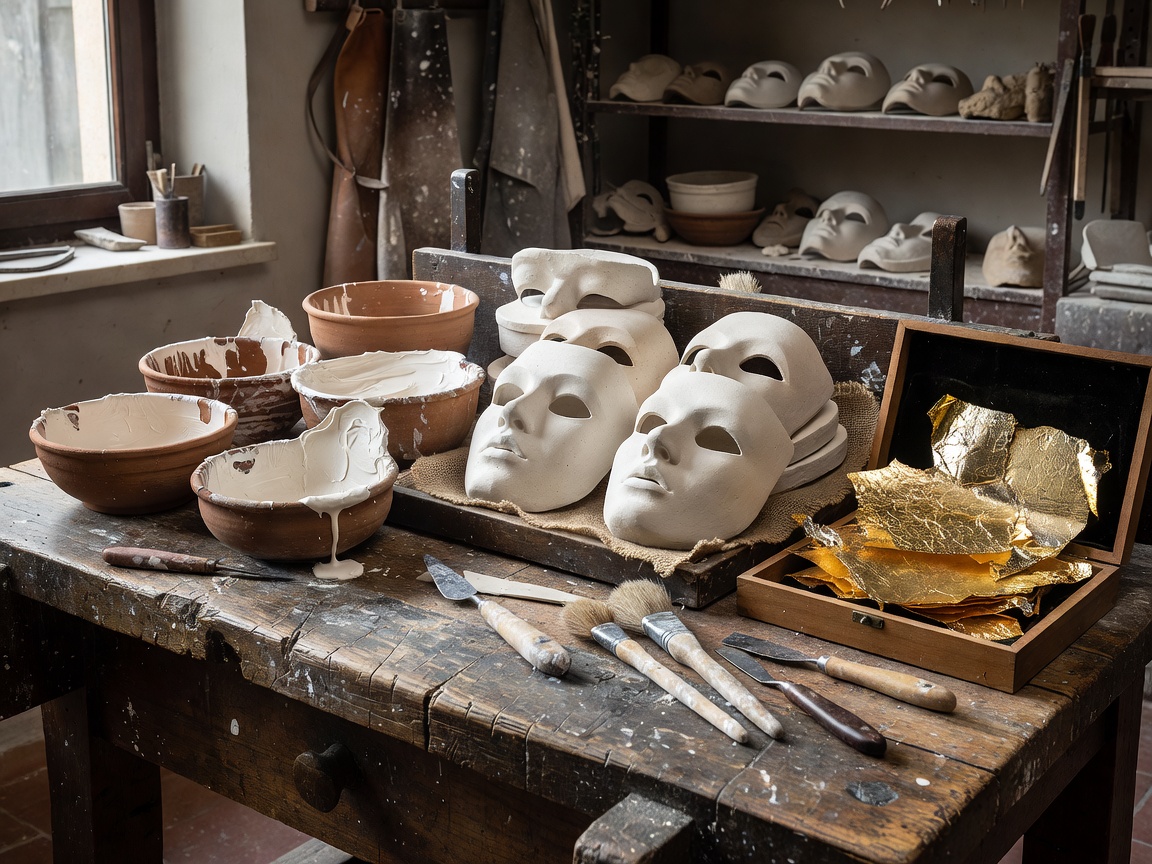
Authentic Venetian masks are never poured from liquid resin or pressed from thin PVC. The maker begins by sculpting a positive clay face, sealing it with soapy release agent, and casting a heavy two-piece plaster of Paris negative mold. Into that hollow interior, artisans lay torn strips of unsized cotton-rag paper brushed with cold flour paste or rabbit-skin glue. Three overlapping cross-grain layers cure overnight until the shell dries rigid yet weighs under ninety grams.
After extraction, the rim is trimmed with shears, sanded with pumice, and coated in three layers of warm bole and white gesso. Painters then apply egg tempera crackle glazes, burnt umber patina, or twenty-four-karat gold leaf burnished with agate stone. This porous interior absorbs perspiration during multi-hour strolls across cold marble bridges, making paper masks vastly more wearable than molded plastic imitations.
Civic Silhouettes: Bauta, Moretta, and Gnaga
Eighteenth-century Venetian law regulated which masks could be worn inside public ridotti, theaters, and voting halls. The Bauta—a stark white jawline projecting outward beneath a black silk zendale hood and three-cornered tricorno hat—distorted the wearer's voice while leaving room beneath the chin to drink wine or eat pastries without uncovering one's face. Because every citizen wearing a Bauta looked identical, noblewomen and dockworkers greeted one another as "Sior Maschera."
By contrast, the oval black-velvet Moretta had no ties or ribbons; women held it against their faces by biting a small glass button fixed inside the mouth, enforcing silence during convent visits and gaming rooms. Meanwhile, the Gnaga paired a feline half-mask with a wicker basket carried on one arm, allowing satirists to mew sharp political rhymes through the alleys of San Polo. Today, costumed participants re-enact those silhouettes during the Festa delle Marie procession from San Pietro di Castello and the Flight of the Angel from the bell tower of San Marco.